
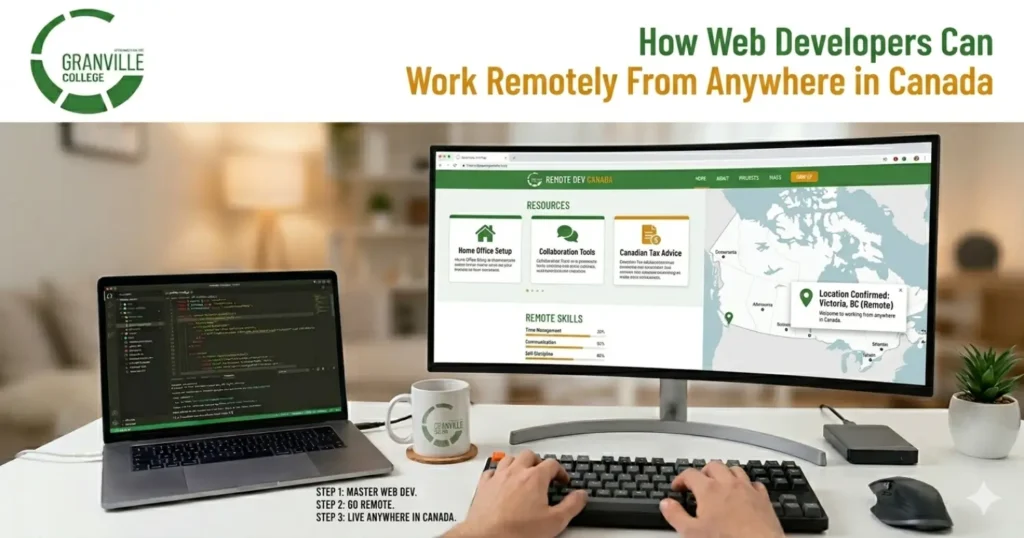
Remote work is no longer just a perk in tech. For many digital roles, it has become a practical and realistic way to build a career. That is especially true for web development, where much of the work already happens through code repositories, project boards, cloud tools, documentation, and online collaboration. Statistics Canada has reported a sharp rise in Canadians working from home for employers located in another province, growing from 12,600 in 2016 to 179,000 in June 2022. This trend shows that cross province remote work is becoming more normal, even if it is still only a portion of the labour market. (Statistics Canada)
For people searching remote web developer jobs in Canada, that shift creates real opportunity. Job Bank lists a median wage of $38.46 per hour for web developers in Canada, and in British Columbia the outlook for web developers and programmers is rated Moderate for the 2025 to 2027 period, supported by employment growth and several new positions. In other words, this is a career path with both flexibility and practical demand. (Job Bank)
The good news is that working remotely from anywhere in Canada is possible for web developers. The more important question is how to do it well. Remote work is not just about coding from home. It is about building the right skills, using the right workflows, proving your value to employers, and understanding the practical realities of working across provinces.
Why web development works well as a remote career
Web development is one of the clearest remote friendly careers because the core work is online by nature. A developer can build interfaces, write back end logic, fix bugs, review pull requests, deploy updates, and document work without needing to be in a physical office every day. Job Bank’s labour market summary for web developers highlights competencies such as digital production, digital literacy, troubleshooting, systems analysis, and oral communication, which all align well with modern remote work.
This does not mean every employer offers a fully remote setup. Some companies still prefer hybrid work, and some teams want occasional in person meetings. But the job itself is highly teleworkable. Statistics Canada’s work on teleworkable jobs in the Greater Toronto Area found many concentrated pockets of jobs that can be done from home, especially in urban business centres. That supports the broader point that knowledge work, including digital work, is often structurally suited to remote arrangements.
What remote web developer jobs in Canada usually involve
When people search for remote web developer jobs in Canada, they often imagine one standard role. In reality, remote work can look different depending on the company and the specialty.
Common remote web development paths include:
- front end development
- back end development
- full stack development
- e-commerce development
- CMS development
- website maintenance and support
- web application testing and optimization
- freelance or contract development
A junior front end developer might spend the week building responsive components, fixing layout bugs, and testing accessibility. A full stack developer might handle APIs, database queries, deployment, and feature work across the whole product. A freelance web developer might manage client communication, timelines, revisions, and site launches independently.
The important takeaway is that remote web developer jobs in Canada are not limited to one kind of employer. They can exist in agencies, startups, SaaS companies, universities, nonprofits, corporate teams, ecommerce businesses, and freelance practice.
The skills employers want from remote web developers
To work remotely from anywhere in Canada, coding skills alone are not enough. Remote employers want people who can deliver work without constant supervision, stay organized, and communicate clearly.
1. Core technical skills
A remote web developer should be comfortable with at least some of the following:
- HTML, CSS, and JavaScript
- responsive design
- version control
- front end frameworks
- back end basics
- APIs
- testing and debugging
- deployment workflows
- database fundamentals
The exact stack depends on the role, but employers still want the basics done well.
2. Written communication
Remote teams rely heavily on messages, tickets, comments, documentation, and handoff notes. GitHub’s own engineering team describes using issues, pull requests, projects, and discussions to track work, collaborate on features, and share information across teams. That kind of workflow depends on writing clearly, not just coding well.
3. Time management
Remote developers need to manage their day without waiting for someone to stand beside them and explain every next step. Being reliable with deadlines, estimates, and check-ins matters.
4. Problem solving
Employers hire developers to solve problems, not only to follow tutorials. Remote developers especially need to troubleshoot independently before escalating.
5. Professional judgment
Remote work gives people more freedom, but it also requires more trust. Employers notice developers who can make sensible decisions, ask good questions, and stay accountable.
How to qualify for remote web developer jobs in Canada
A lot of people want flexibility, but employers still hire based on proof. If your goal is to win remote web developer jobs in Canada, focus on making your value easy to see.
Build a portfolio that proves you can work independently
A strong portfolio matters even more for remote roles because employers want evidence that you can build, finish, and explain real work.
Your portfolio should include:
- 3 to 5 polished projects
- live demos
- GitHub links
- a short explanation of what each project does
- your role and responsibilities
- the tools used
- challenges solved
- mobile friendly design
- clear contact details
The best portfolios do not just show screenshots. They show thinking. Explain why you built something, how you structured it, and what you learned. That helps employers imagine how you would perform on a remote team.
Make your GitHub part of your professional identity
For remote developers, GitHub often acts like a working resume. Even when employers do not read every line of code, they do notice consistency, documentation, repository organization, and contribution habits.
Your GitHub profile should feel clean and intentional:
- pin your best repositories
- write useful READMEs
- remove or archive unfinished clutter
- use clear repository names
- keep recent activity visible when possible
This helps support your applications for remote web developer jobs in Canada because it gives hiring teams confidence that you can work in collaborative, code based environments.
Learn to work asynchronously
A lot of remote success comes from asynchronous work. That means progress does not always depend on live meetings. GitHub’s engineering practices highlight issues, pull requests, projects, and discussions as ways to plan, review, and document work across teams. For remote web developers, this is a major advantage because strong async habits let you work effectively whether your employer is in Toronto, Vancouver, Calgary, or Halifax.
Here is what good async work looks like:
- writing clear updates
- opening well explained pull requests
- documenting blockers early
- asking specific questions
- leaving useful comments for teammates
- keeping project boards current
- summarizing decisions in writing
This is one of the biggest reasons web developers can work remotely from anywhere in Canada. Good processes reduce the need to be physically together.
Understand the real market for web developers in Canada
It helps to go into the job search with realistic expectations. Web development can offer flexibility, but the market still varies by role and region.
Job Bank reports a median wage of $38.46 per hour in Canada for web developers and programmers. In British Columbia, the listed wage range is $20.00 to $65.00 per hour, while Ontario shows $21.63 to $56.41 per hour. In the Toronto region, the median is $39.42 per hour. These numbers show that pay can vary based on region, experience, employer type, and specialization.
Snapshot of web developer pay
| Location | Low hourly wage | Median hourly wage | High hourly wage |
| Canada | N/A | $38.46 | N/A |
| British Columbia | $20.00 | $37.50 | $65.00 |
| Ontario | $21.63 | $40.00 | $56.41 |
| Toronto region | $21.63 | $39.42 | $52.31 |
Source: Job Bank wage reports for web developers and programmers. (Job Bank)
On the opportunity side, British Columbia’s 2025 to 2027 outlook for web developers and programmers is Moderate, and the province’s outlook notes employment growth leading to several new positions. That is encouraging for anyone preparing to compete for remote web developer jobs in Canada.
How to search for remote web developer jobs in Canada more effectively
A lot of job seekers apply broadly but too vaguely. A smarter search is more targeted.
Focus on the right job titles
Search beyond just “web developer.” Try:
- front end developer
- back end developer
- full stack developer
- web application developer
- WordPress developer
- ecommerce developer
- junior developer
- application support developer
Show remote readiness in your application
Your resume and cover letter should make remote work feel low risk for the employer. Mention:
- experience working independently
- project documentation
- GitHub workflow
- collaboration tools
- deadlines met
- client or team communication
- deployed projects
Apply across provinces
Because remote work can disconnect your home location from your employer’s office, applying outside your city makes sense. Statistics Canada found that by June 2022, 179,000 Canadian employees working from home were reporting to a worksite in another province. That number shows cross province employment is real and growing.
Practical reality: living in one province and working for an employer in another
This is where the “from anywhere in Canada” idea becomes real. You may live in Winnipeg and work for a company in Vancouver. You may live in Halifax and work for a Toronto agency. That can be excellent for flexibility, but there are practical details to check.
The CRA says employers must determine an employee’s province or territory of employment so the correct payroll deductions are withheld. The CRA also notes that if a worker’s province of employment is different from their province of residence, the tax deducted at source may be too high or too low.
That does not mean cross province remote work is a problem. It just means you should ask smart questions before accepting an offer:
- Is my work location approved for permanent remote work?
- How does payroll handle my province of residence?
- Are there equipment or security rules for remote staff?
- Will salary be location based or role based?
- Are there required travel days for meetings or team events?
As a job seeker, asking these questions makes you sound prepared, not difficult.
A simple remote work setup that helps developers succeed
You do not need a perfect influencer style home office. You do need a professional setup that supports consistent work.
A strong baseline includes:
- reliable internet
- a quiet workspace
- a second screen if possible
- a good webcam and microphone
- secure password management
- routine backups
- clear working hours
- a system for task tracking
Remote employers want output and reliability. A clean setup helps you produce both.
Example career paths for web developers working remotely in Canada
To make the idea more practical, here are three realistic examples.
Example 1: Junior front end developer
A new graduate in Edmonton builds a portfolio with three clean React projects, contributes to GitHub regularly, and applies to remote agency jobs in Vancouver and Toronto. Their first role is remote, with weekly standups and mostly async task work.
Example 2: Full stack developer
A developer in London, Ontario has a few years of experience and strong API and database skills. They move into a fully remote SaaS role with a Calgary company and work mostly through pull requests, tickets, and written updates.
Example 3: Freelance web developer
A web developer in Moncton works remotely for small businesses across Canada, building marketing websites, landing pages, and ecommerce updates. Their success depends as much on communication and project scope as on code quality.
These paths look different, but all of them show the same thing: remote success comes from skills, proof, and process.
Best habits for keeping a remote web development job
Getting hired is one thing. Keeping the job and growing in it is another.
The strongest remote developers tend to:
- communicate early, not late
- document their work clearly
- ask better questions
- avoid disappearing when stuck
- review code thoughtfully
- improve estimates over time
- protect deep work time
- stay professional in written communication
Remote work rewards consistency. It also makes reliability more visible.
Final thoughts
Web development is one of the most practical careers for location flexibility in Canada. The role is digital by nature, the collaboration tools already exist, and cross province remote work is becoming more common. Labour market data still shows meaningful wages, and provinces such as British Columbia continue to show moderate outlooks for the occupation.
For anyone aiming at remote web developer jobs in Canada, the path is straightforward even if it takes work. Build strong skills. Create a polished portfolio. Keep your GitHub professional. Learn async communication. Apply across provinces. Ask smart payroll and work location questions. Then keep proving that you can deliver good work without needing to be in the same room as your team.
That is how web developers can work remotely from anywhere in Canada.
FAQs
-
Can web developers really work remotely from anywhere in Canada?
Yes. Many web development tasks are fully digital, so developers can often work from home in another city or province, as long as the employer supports remote arrangements and handles payroll properly.
-
Are remote web developer jobs in Canada common?
They are common enough to be a real career option, especially in digital teams. Web development is highly teleworkable because coding, reviews, testing, and deployment can all be done online.
-
What skills help most with remote web developer jobs in Canada?
Strong coding fundamentals matter, but so do written communication, documentation, time management, Git workflows, troubleshooting, and the ability to work independently without constant supervision.
-
Do remote web developers need a portfolio?
Yes. A portfolio helps employers see proof of skill, project quality, and independent work. For remote roles, that proof matters even more because employers want confidence before hiring someone they may never meet in person.
-
Is GitHub important for remote web development jobs?
Yes. GitHub helps employers see code quality, project history, documentation, and collaboration habits. It also reflects whether you understand pull requests, repositories, and clean development workflows.
-
What is the average web developer salary in Canada?
Job Bank reports a median wage of $38.46 per hour for web developers in Canada. Actual pay varies by region, employer, specialization, and level of experience.
-
Can I live in one province and work remotely for a company in another?
Yes, but ask about payroll and approved work location first. The CRA says employers must determine the province of employment for correct deductions, which may differ from your province of residence.
-
Do remote web developers need to be online all day?
Not always. Many remote teams work asynchronously, which means progress is tracked through tickets, pull requests, and written updates rather than constant live meetings.
-
Is remote web development good for beginners?
It can be, but beginners usually need stronger portfolios and clearer communication to compete. Employers want proof that junior developers can stay organized, ask good questions, and finish tasks reliably.
-
What tools do remote web developers use most?
Common tools include code repositories, issue trackers, pull requests, project boards, documentation systems, messaging tools, and video calls. GitHub highlights issues, pull requests, projects, and discussions as core collaboration tools.
-
Should I apply only in my own city?
No. One of the biggest advantages of remote work is that you can apply across provinces. Statistics Canada shows that working from home for an employer in another province has increased sharply over time.
-
Is the outlook good for web developers in British Columbia?
Job Bank rates the outlook for web developers and programmers in British Columbia as Moderate for 2025 to 2027, with employment growth expected to create several new positions.